Whether you’re just starting out as a nail technician or you’ve been doing nails for years, having the right professional nail supplies can make or break your results. The tools you use directly impact the quality of your work, your client satisfaction, and even how efficiently you move through appointments. So if you’ve been making do with whatever’s available, it might be time to upgrade your kit — seriously.
This guide walks you through everything you need to know: the must-haves, the nice-to-haves, how to choose quality over quantity, and the common mistakes even experienced nail techs make when shopping for supplies.
Why Professional Nail Supplies Actually Matter
Let’s be real — there’s a big difference between drugstore nail products and salon-grade tools. Professional-grade supplies are formulated and engineered for repeated, high-performance use. They’re designed to give consistent results, last longer, and work better on real nails under real salon conditions.
Here’s a simple breakdown of how professional supplies compare to consumer-grade ones:
| Feature | Consumer/Drugstore Products | Professional Nail Supplies |
|---|---|---|
| Pigment concentration | Lower, often requires more coats | Higher, often opaque in 1–2 coats |
| Durability | Chips within days | Lasts 2–4 weeks with proper prep |
| Tool precision | Basic, limited control | Engineered for accuracy and control |
| Safety standards | Varies widely | Often tested to professional safety standards |
| Cost per use | Appears cheaper upfront | Lower cost per service over time |
| Product consistency | Can vary batch to batch | Formulated for reliable results |
Investing in better tools doesn’t just improve your client’s nails — it protects your reputation and your income.
Essential Professional Nail Supplies Every Tech Should Own
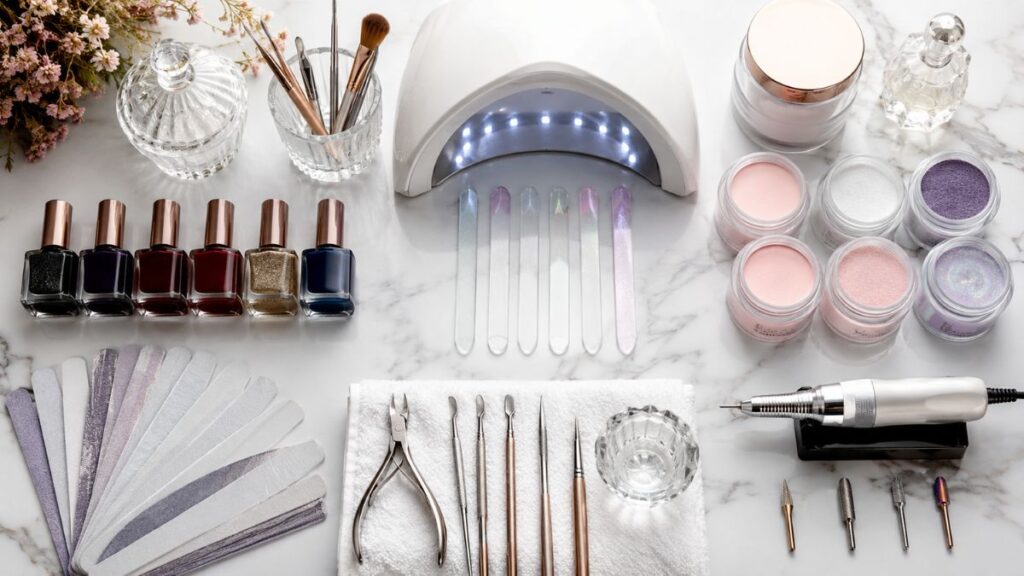
This is the core of any nail kit. If you’re building your station from scratch or doing a refresh, these are the categories you cannot skip.
Nail Files and Buffers
Files are the backbone of prep work. A good file shapes, refines, and smooths without causing micro-tears in the nail plate. You’ll want a selection of grits:
- 80–100 grit — For heavy shaping or removing product
- 150–180 grit — For natural nails and light shaping
- 220–240 grit — For smoothing and prepping the nail surface
- Buffer blocks — For adding shine to natural nails before polish
Glass and crystal files are popular among professionals because they seal the nail edge as they file, which reduces breakage and peeling. They’re also easier to sanitize than foam-core files.
Nail Drills and E-Files
An electric file, or e-file, is one of the most used tools in a modern nail salon. They speed up removal, prep, and finishing — but only when used correctly. Look for:
- Adjustable RPM (ideally 3,000–35,000 RPM range)
- Low vibration for client comfort
- A good selection of compatible drill bits
- Forward and reverse rotation settings
The quality of drill bits matters just as much as the machine itself. Ceramic bits are gentler on the natural nail, while carbide bits are better for bulk product removal.
Cuticle Care Tools
Cuticle care is one of the biggest differentiators between an amateur and a polished nail tech. Stainless steel tools are the standard for professional use — they’re durable, sterilizable, and precise.
Must-have cuticle tools include:
- Cuticle pusher (flat and angled)
- Cuticle nippers (with a sharp, clean jaw)
- Cuticle remover solution or gel
- Manicure brushes for debris removal
Avoid cheap nippers — they tend to tear rather than cut cleanly, which can cause client discomfort and jagged cuticles.
Gel, Acrylic, and Nail Enhancement Products
This is where professional nail supplies really diverge from what you find in a standard store. The chemistry in professional enhancement products is specifically designed for salon use.
Gel Polish Systems
A quality gel polish system includes more than just the polish itself. You’ll need:
- Base coat — Bonds the gel to the natural nail
- Color gels — High-pigmentation formulas
- Top coat — Seals and protects (glossy or matte finish)
- Gel cleanser/remover — To wipe the inhibition layer and break down cured gel
Always match your base, color, and top coat within the same brand system when possible. Cross-brand mixing can cause adhesion issues, lifting, or even allergic reactions over time.
Acrylic Systems
Acrylic nails are created using a liquid monomer and a powder polymer. The mix ratio is critical. Too wet and the product sets slowly and lifts; too dry and it sets too fast and becomes brittle.
| Acrylic Component | Purpose | Key Quality Markers |
|---|---|---|
| Liquid monomer | Activates the powder, creates workable bead | Low odor, correct viscosity, MMA-free |
| Acrylic powder | Provides structure and color (pink, white, clear) | Fine milling, consistent particle size |
| Primer | Promotes adhesion to natural nail | Acid-based or acid-free depending on system |
| Nail forms | Supports free edge during extension | Fit variety, flexible, adhesive backing |
| Acrylic brush | Applies product bead | Kolinsky or synthetic, pointed belly |
Important: Always check that your monomer is MMA (methyl methacrylate) free. MMA monomers are banned or restricted in many countries due to health risks and are a sign of a low-quality product.
UV/LED Lamps and Curing Equipment
No gel application is complete without a curing lamp. When selecting a professional lamp, consider:
- Wattage — 36W minimum; 48W+ recommended for faster curing
- LED vs. UV — LED lamps cure most modern gel formulas faster and have a longer bulb life
- Curing time — Varies by product (always follow the brand’s recommended time)
- Timer settings — 10, 30, and 60-second options give flexibility
- Size — Wider lamps accommodate both hands or feet for efficiency
Some gel systems are UV-only, some are LED-only, and many are dual-cure. Check your gel brand’s specifications before buying a lamp.
Pros and Cons of Investing in High-End Nail Supplies
Before you go on a full shopping spree, it’s worth knowing what you’re getting into.
Pros:
- More consistent results with fewer coats or applications
- Tools last significantly longer, reducing replacement costs
- Clients notice the difference in finish quality
- Professional products often have better warranty or support
- Safer formulations — especially important for sensitive clients
Cons:
- Higher upfront investment
- Some brands have a learning curve
- Requires ongoing education as new systems are introduced
- Not all expensive products perform better — research still matters
Common Mistakes When Buying Nail Supplies
Even seasoned nail techs fall into these traps. Here’s what to avoid:
1. Buying everything from one generic supplier without researching brands. Not all professional-labeled products are truly professional grade. Look for reviews within the nail tech community, not just the supplier’s website.
2. Skipping sanitization supplies. Your tools are only as good as how clean they are. Build your sanitation kit alongside your tools — proper barbicide, UV sanitizer boxes, and disposable barriers are non-negotiable in a professional setting.
3. Neglecting client safety when choosing products. Always check ingredients for allergens and irritants, especially in primers and monomers. Offer patch tests where appropriate.
4. Overloading your kit with duplicate tools. It’s tempting to buy every version of a nail file or brush, but a lean, high-quality kit outperforms a cluttered one every time.
5. Ignoring continuing education. Products evolve. Application techniques change. The best nail techs invest in training as much as they invest in tools.
Best Practices for Managing Your Nail Supply Kit
Keeping your supplies organized and well-maintained is part of running a professional nail business. Here’s a quick-reference framework:
| Practice | Why It Matters | How Often |
|---|---|---|
| Sanitize metal tools | Prevents cross-contamination | After every client |
| Replace nail files | Files lose grit and harbor bacteria | Every 1–4 weeks depending on use |
| Check product expiry dates | Expired products cause adhesion failure | Monthly |
| Inventory your stock | Prevents running out mid-appointment | Weekly |
| Store products correctly | Heat and light degrade formulas | Ongoing |
| Update your lamp bulbs (UV) | Fading bulbs under-cure gel | Every 6 months |
A well-maintained kit is a sign of a professional who takes their craft seriously — and clients pick up on that.
Conclusion
Building a strong collection of professional nail supplies is one of the best investments you can make in your career. The right tools give you more control, better outcomes, and happier clients. Start with the essentials, invest where quality matters most, and slowly build out your kit as your skills and clientele grow.
Don’t chase trends — chase reliability. The brands and tools that consistently deliver will always outperform the shiny new thing that just dropped on social media. Do your research, trust your instincts, and never underestimate the difference a good set of tools makes.
And if you are just getting started or looking to level up your overall nail game, our complete pro nails guide covers everything from nail care routines to the best nail art techniques — all in one place.
Frequently Asked Questions
A beginner nail tech should prioritize a quality nail file set (multiple grits), cuticle tools, a gel polish starter kit with a UV/LED lamp, acrylic system basics (monomer, powder, and brush), and proper sanitation supplies. Start lean and build your kit as your client base grows.
Professional nail supplies are formulated for salon use, offering higher pigment concentration, longer durability, safer ingredients (such as MMA-free monomers), and better consistency. They are also designed for repeated use and sterilization, unlike consumer-grade products.
Metal tools like cuticle nippers and pushers should be sanitized after every client and replaced when they show dullness or damage. Nail files should be replaced every one to four weeks. UV lamp bulbs should be changed every six months or so to ensure proper curing.
Yes, in most cases. While the upfront cost is higher, professional-grade tools and products deliver better results, last longer, and reduce the risk of client reactions or adhesion failures. The cost per service is often lower in the long run.
Nail technicians can shop from dedicated professional beauty distributors, manufacturer brand websites, and licensed beauty supply stores. Some suppliers require a cosmetology license or business registration to access professional pricing.